Vaxart (VXRT) Oral Vaccine Platform Overview & Scenario Analysis
This page provides an independent, platform-level analysis of Vaxart (VXRT), focusing on its oral vaccine technology, mucosal immunity science, clinical development across multiple indications, and long-term strategic scenarios.
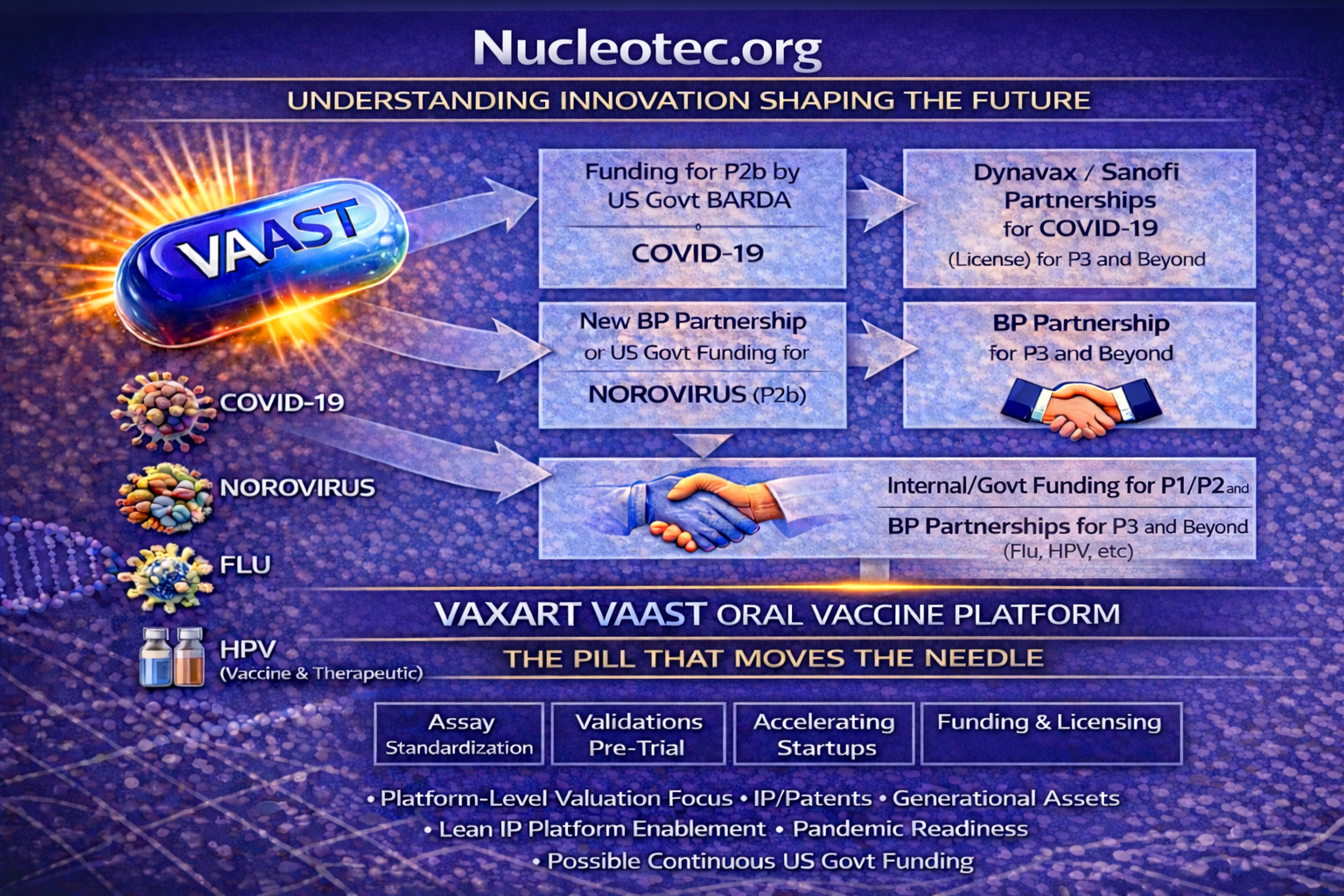
From a platform lens, VAAST is evaluated less as a single vaccine asset and more as reusable oral-immunization infrastructure. If adoption broadens across partners, public-sector programs, and multiple antigens, value creation is driven by platform leverage, intellectual property durability, and capital-efficient enablement rather than any one product outcome.
This overview is intended to support high-level thinking about Vaxart (VXRT) stock and platform valuation scenarios as a platform-level valuation (scenario-based) framework. It is purely informational and does not constitute investment advice or a price target.
- High-level overview of Vaxart’s VAAST oral vaccine platform and mucosal immunity thesis.
- How Norovirus and COVID programs inform platform-level validation.
- Strategic scenarios for VAAST as a reusable, long-term platform.
- Links to deeper research, validation signals, and ongoing platform updates.
If you are reading this from a VXRT stock or valuation perspective, you may want to jump directly to the four‑scenario strategic model section below, which frames VAAST in platform‑level, scenario‑based terms.
For readers seeking a more detailed, long‑form analysis, including extended scenario‑based platform valuation discussion, see the Vaxart (VXRT) Oral Vaccine Platform Deep‑Dive .
Re‑defining global immunization through oral vaccine platforms, mucosal immunity, and reusable development standards.
A. One‑Page Refined Thesis
VAAST refers to Vaxart’s oral antigen delivery platform designed to program mucosal and lymph node–mediated immune responses, rather than a single disease‑specific vaccine.
Oral vaccine platforms have the potential to change how immunization programs are designed by improving accessibility, reducing logistical complexity, and enabling immune responses at mucosal entry points. If validated over time, such platforms could support new regulatory standards, reusable assays, and shared development tools that benefit the broader vaccine ecosystem — not just a single product or company.
Vaxart, Inc. is developing an oral vaccine platform designed to induce both mucosal and systemic immune responses. The scientific premise is that targeting immune responses at mucosal entry points may offer advantages for certain respiratory and enteric pathogens. This platform‑centric approach differentiates Vaxart from traditional injectable vaccine technologies.
A core attribute of Vaxart’s approach is platform reuse: the same oral delivery system, vector backbone, and immune-response assays are applied across different antigens and disease targets, rather than rebuilt independently for each program.
Beyond individual vaccine candidates, the broader ambition of oral vaccine platforms is the potential to re‑define how global immunization programs are designed and delivered. Oral formulations may lower logistical barriers, improve accessibility, and enable new approaches to immunization where injections are less practical or less accepted.
Over time, successful oral vaccine development could contribute to the establishment of new scientific and regulatory standards, including standardized mucosal immune assays, correlates of protection, and platform tools that may support the development of multiple vaccines across different pathogens. Such standards, if adopted, could benefit not only a single company but the broader vaccine ecosystem.
The company is transitioning beyond early platform validation, with clinical programs advancing into later-stage development. Ongoing and upcoming studies in Norovirus Phase 2 and COVID Phase 2b—alongside planning considerations for potential Phase 3 progression—are increasingly focused on consistency of immune signaling, biological plausibility at scale, and repeatability across cohorts rather than exploratory proof-of-concept alone. As a result, the platform’s long-term value is likely to be shaped by cumulative data coherence across indications, study designs, and populations.
Related concepts: VAAST platform, oral vaccines, mucosal immunity, platform reuse, immunization strategy.
From a strategic perspective, Vaxart represents a platform asset moving toward a more advanced stage of development, with multiple potential future pathways including continued independent execution, expanded public-sector engagement, strategic partnerships, or acquisition. Although outcomes depend on execution, the direction of clinical progress and emerging data trends support a more constructive platform outlook, with valuation increasingly driven by advancing data maturity, regulatory alignment, and execution discipline as programs move forward.
B. How do clinical programs inform platform validation?
Rather than evaluating Norovirus and COVID as isolated programs, they can be viewed as parallel test cases for the same oral vaccine platform operating across two biologically distinct pathogen classes (enteric and respiratory). Observing similar immune‑pathway activation across both indications strengthens confidence in platform consistency rather than single‑asset performance.
Norovirus data points highlight gut‑mucosal engagement and durability signals, while COVID studies emphasize nasal and systemic immune activation. Taken together, these programs help assess whether the platform reliably triggers mucosal immunity across different entry points — a core hypothesis behind oral vaccine design.
Importantly, these observations do not constitute proof of clinical efficacy. Instead, they function as platform‑level validation signals that inform future study design, regulatory dialogue, and funding prioritization. Consistency across indications matters more at this stage than peak results in any single program.
Related concepts: norovirus vaccine, COVID-19 oral vaccine, mucosal IgA, platform validation, immune consistency.
C. Four‑Scenario Strategic Model
| Independent Platform Builder | Vaxart advances its oral vaccine platform independently using government funding and selective collaborations. | Maximum long‑term platform and IP value retention | Longer timelines and execution dependency |
| Partnership‑Led Expansion | Licensing and co‑development deals fund expansion while sharing risk. | Capital efficiency and risk reduction | Capped upside due to revenue sharing |
| Lean IP Platform Enablement |
Vaxart operates as a capital-efficient, IP-led platform company focused on proprietary oral vaccine technology, immune-response assays, and early- to mid-stage clinical enablement. External partners assume primary responsibility for late-stage clinical execution, manufacturing scale-up, and commercialization, while Vaxart concentrates on platform development, standardization, and scientific validation.
Over time, this may include contributing to assay frameworks, evaluation methodologies, and best-practice standards in collaboration with regulators and public-sector stakeholders. |
High-margin, lower balance-sheet risk model driven by platform licensing, development milestones, royalties, assay enablement, and potential public-sector funding support. | Dependent on partner adoption, clarity of assay-to-outcome translation, competitive differentiation versus other oral or mucosal platforms, evolving regulatory expectations, and sustained execution discipline. |
| Strategic Acquisition | A larger pharmaceutical company acquires Vaxart after sufficient de‑risking. | Immediate value realization | Timing and valuation uncertainty |
From a stock‑market perspective, many readers discuss VXRT as a platform‑driven biotechnology company rather than a single‑asset vaccine developer, with platform‑level valuation framed in scenario‑based terms that emphasize adoption, intellectual property durability, and partner participation rather than short‑term price targets.
Strategic Interpretation
Based on recent operational and organizational signals, the Lean IP Platform Enablement model appears increasingly aligned with the company’s direction of travel. Indicators such as facility lease termination, targeted hiring focused on assay development, consolidation and modification of existing facilities to support employees, and the planned closure of the headquarters license suggest a deliberate shift toward a more capital-efficient, IP-centric operating structure.
Collectively, these actions are consistent with a strategy that prioritizes proprietary platform intellectual property, assay development, and scientific enablement over maintaining expansive physical infrastructure or vertically integrated manufacturing capabilities. In parallel, increased emphasis on assay development and immune-response measurement aligns with potential engagement in public-sector–supported programs, where standardized evaluation frameworks and reproducible immune markers are increasingly important.
Over time, this positioning may allow the platform not only to benefit from future government or public-sector funding initiatives, but also to contribute to the development of assay methodologies, validation approaches, and evaluation standards that could become reference points for oral or mucosal vaccine programs. While this does not imply formal regulatory endorsement, consistent adoption of platform assays and methodologies across programs could support de facto standardization in collaboration with regulators and public-health stakeholders.
Importantly, as the platform matures, the associated patents, proprietary assays, and accumulated clinical and regulatory know-how may increasingly function as long-lived or generational intellectual property assets. Such assets can be reused across multiple indications and partners over extended periods, potentially enhancing the durability of the platform’s value and contributing positively to long-term company valuation beyond individual product cycles.
Taken together, these signals support the view that the company may be positioning itself as a lean platform partner—focused on IP, assays, and clinical enablement—while relying on external partners for late-stage clinical execution, manufacturing, and commercialization. This approach emphasizes scalability, capital efficiency, and platform leverage rather than asset-heavy vertical integration.
Related concepts: VXRT stock valuation, platform biotech, oral vaccine platform, lean IP enablement, mucosal immunity, pandemic preparedness infrastructure.
D. Platform Narrative
From a platform perspective, HPV‑associated disease is often discussed as a representative mucosal‑site condition where therapeutic immune programming may eventually be relevant, rather than as a currently disclosed clinical program.
Tablet-based administration, room-temperature stability, scalable manufacturing
Gut & nasal immune engagement, IgA signaling, potential impact on transmission
Shared constructs and assays applied across multiple pathogens
Potential for collaboration with government and global health programs
Platform Diagram
The diagram below illustrates, at a high level, how the oral tablet platform is intended to work. It is a conceptual view based on publicly described features of Vaxart’s technology and is for educational purposes only.
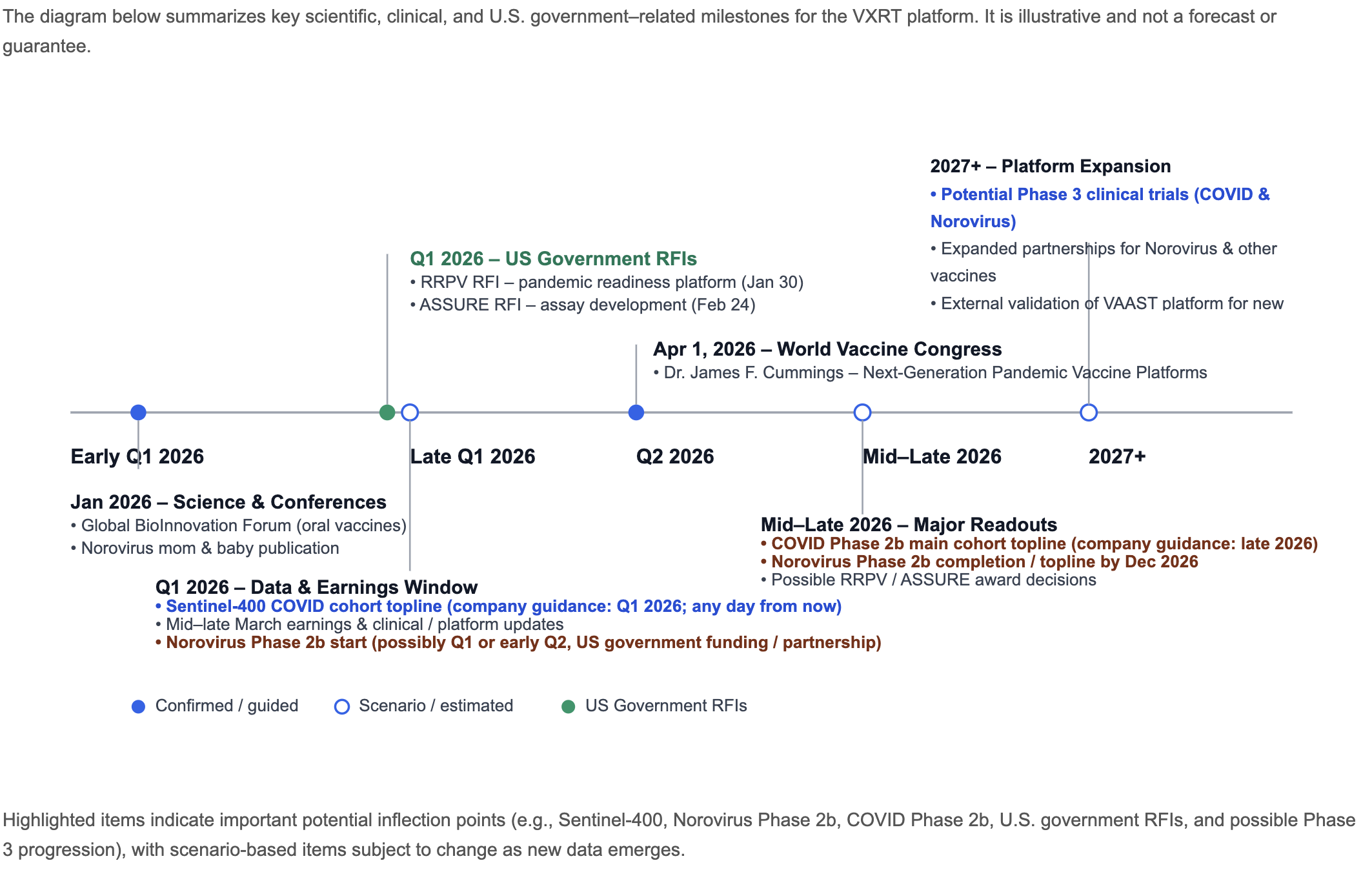
E. Platform Timeline
Further Reading
Explore the detailed Vaxart (VXRT) Oral Vaccine Platform Deep-Dive for a comprehensive, independent analysis, or follow ongoing platform updates in the Vaxart Research Log .
In general, platform companies are often re-rated not when a single product succeeds, but when their infrastructure becomes visibly embedded across multiple programs, partners, and preparedness efforts—a lens that may be useful when thinking about long-term VXRT valuation without relying on any specific price target.